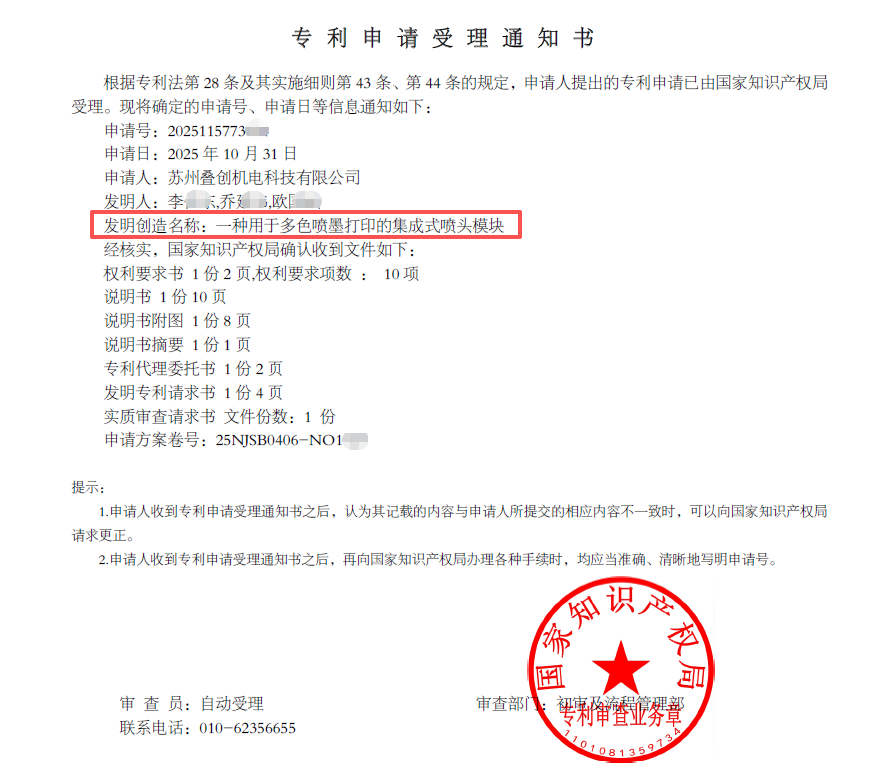




Integrated Nozzle Module for Multi-Color Inkjet Printing: A Precision Breakthrou
2025-10-31
I. Core Challenges Amid Industry Transformation: Balancing Width, Speed, and Precision
With the accelerated digital transformation of the packaging industry, personalized customization and small-batch quick-response orders driven by e-commerce have been on the rise. Printing requirements for large-format substrates such as corrugated cardboard and large cartons present three core demands: wider width, faster speed, and higher precision. Traditional printing technologies struggle to adapt to flexible production scenarios, making digital inkjet printing a key solution. However, the industry has long faced a critical technical bottleneck: the effective printing width of industrial inkjet heads (piezoelectric or thermal bubble type) is generally limited to ≤130mm, creating a significant gap with the industrial large-format printing needs of over 600mm.
To achieve single-pass full-coverage printing, the industry commonly adopts multi-nozzle array combinations. Yet this model has been plagued by a dual contradiction between "seamless connection" and "precision control." How to break through the printing width limit while avoiding splicing defects has become a core pain point for the large-scale application of multi-color inkjet printing technology.
II. Limitations of Traditional Splicing Schemes: Fragile Dependence on "Perfect Speed"
The current mainstream "stepped staggered splicing" scheme is a compromise constrained by the physical structure of traditional rectangular nozzles. To avoid shell interference, this scheme installs nozzles staggered forward and backward along the paper feed direction, then relies on precise electronic delay control to make the rear nozzles "wait" for the substrate to move to the correct position before jetting ink, thereby theoretically achieving ink droplet alignment.
The fundamental weakness of this scheme lies in its extremely fragile stability. Its printing precision is completely tied to the "absolute constancy" of the substrate's movement speed. However, in actual industrial environments, minor speed fluctuations caused by mechanical transmission errors, uneven substrate thickness, or system vibration are unavoidable. Any speed deviation will invalidate the preset delay, directly resulting in visible defects in the splicing area of printed products—such as misaligned, broken, or blurred lines. These issues are further exacerbated in multi-color overprinting.
III. The Breakthrough: Integrated Innovation from "Software Compensation" to "Hardware Collaboration"
To fundamentally address the above pain points, a new integrated multi-color inkjet printing nozzle module has emerged. Its design philosophy rethinks the collaboration of multiple nozzles from the physical architecture level, with two core innovations:
1. Z-Shaped Integrated Coplanar Layout: Eliminating Physical Stagger
Abandoning the traditional stepped front-back arrangement, this module creatively integrates multiple printing units into a single body using a Z-shaped topology. This design ingeniously eliminates interference between nozzle shells, allowing the nozzle arrays of all printing units to be arranged on the same physical plane (coplanar design). Consequently, positional differences between front and rear nozzles are structurally eliminated, eliminating the need for complex delay algorithms to calculate "when to jet." This completely frees printing precision from sensitivity to paper feed speed fluctuations.
2. Micron-Level Nozzle Collaboration Planning: Ensuring Precise Coverage and Color Overlay
On the basis of coplanarity, the geometric relationships of all nozzles in the module are systematically optimized:
Seamless Connection: Precisely control the spacing and relative positions of nozzles in adjacent printing units to form a continuous, uniform ink droplet coverage band, achieving truly seamless printing width expansion physically.
Color Precision: Optimize the arrangement order and nozzle orientation of printing units for multi-color printing processes (such as CMYK) to ensure ink droplets of different colors overlap in the optimal path, effectively avoiding color deviation and ghosting and improving color reproduction.
Modular Integration: Highly integrate printing units, ink supply systems (adopting balanced pressure supply design), and synchronous drive circuits into a compact module. This not only simplifies installation and calibration but also ensures high consistency of all nozzle actions through hardware-level synchronous triggering, enhancing the overall reliability and response speed of the system.
IV. Application Value: Driving Flexible, High-Quality Packaging Printing
The integrated module brings not only technological advancements but also innovations in production models:
Enhanced Stability: The hardware-level alignment scheme ensures excellent printing quality in the splicing area under varying production speeds and substrate conditions, significantly improving product yield.
Improved Efficiency and Usability: Eliminates complex delay calibration processes, enabling faster equipment commissioning and lowering requirements for operators, making it more adaptable to the fast-paced needs of flexible production.
Expanded Application Scenarios: Provides a reliable and cost-effective solution for personalized, small-batch, high-quality digital printing in fields such as corrugated cartons and large-format display materials, strongly supporting the digital transformation and sustainable development of the packaging industry.
V. Conclusion
Through two core innovations—Z-shaped coplanar integration and micron-level nozzle collaboration—the integrated nozzle module successfully advances the technical path of multi-nozzle combination from "fragile balance relying on software compensation" to "stable foundation based on hardware collaboration." It not only solves a long-standing splicing precision problem but also provides a high-reliability, easy-deployment, high-quality underlying hardware solution for industrial large-format multi-color inkjet printing. This marks a key step toward the maturation and large-scale application of this field, boasting significant industrial promotion value and broad market prospects.